


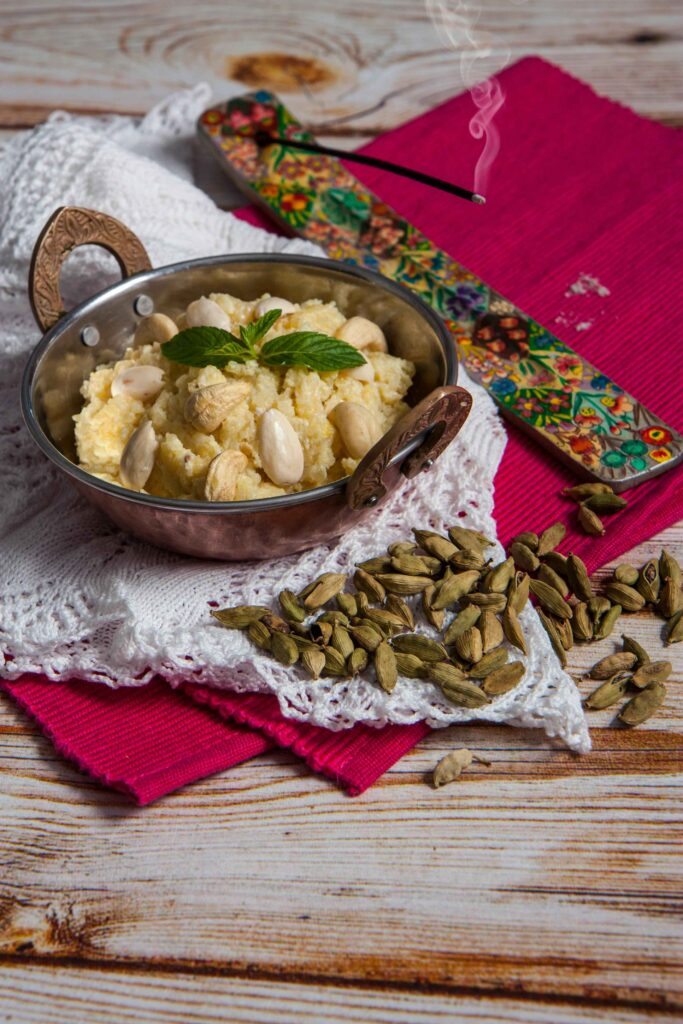
If you’re craving a warm, comforting dessert that’s rich, aromatic, and melts in your mouth with every spoonful, this Suji ka Halwa will absolutely steal your heart. Buttery, fragrant, and brimming with the nostalgic flavors of ghee, cardamom, and roasted semolina, this classic Indian sweet is perfect for everything—from festive celebrations and temple offerings to cozy evenings at home.
Unlike many traditional sweets, Suji ka Halwa (also known as Rava Sheera or Semolina Pudding) is made with just a few pantry staples—semolina, sugar, ghee, and water. Yet the result is deeply satisfying, rich in texture, and soulfully simple. Whether you serve it as a prasad on special occasions or whip it up on a whim to satisfy sudden dessert cravings, this Suji Ka halwa always delivers comfort in every bite.
What truly makes this Suji Ka Halwa special is the process—the way the semolina is patiently roasted in ghee until it turns golden and nutty, then transformed with hot sugar syrup into a fluffy, aromatic halwa. Topped with fried cashews, raisins, and a pinch of saffron, every spoonful is an indulgent experience.
Preparation Time to Make Suji ka Halwa
- Preparation Time: 5 minutes
- Cooking Time: 15 minutes
- Total Time: ~20 minutes
- Servings: 4
Ingredients for Suji ka Halwa
Dry Ingredients:
- Semolina (Suji/Rava) – 1 cup (fine variety preferred) (~160g) (~600 calories)
- Sugar – ¾ cup (~150g) (~580 calories)
- Cardamom Powder – ½ teaspoon
- Salt – A pinch (optional, to balance sweetness)
Wet Ingredients:
- Ghee (Clarified Butter) – ½ cup (~100g) (~900 calories)
- Water – 2½ cups
- Saffron Strands – 6–8 strands soaked in 2 tbsp warm water or milk (optional but recommended)
For Garnish (Optional):
- Cashew Nuts – 10–12 pieces (~60 calories)
- Raisins – 1 tablespoon (~30 calories)
- Almond Slivers – 1 tablespoon (~50 calories)
- Rose Petals – For a touch of elegance (optional)
Instructions: How to Make Suji ka Halwa
Step 1: Prepare the Sugar Syrup
First, in a saucepan, combine 2½ cups of water, sugar, and the soaked saffron (if using).
Heat this mixture on medium flame, stirring occasionally until the sugar fully dissolves.
Then, turn off the heat and set the syrup aside.
Tip: You can also use milk in place of water for a richer version, but water keeps it lighter and more traditional.
Step 2: Roast the Dry Fruits
Meanwhile, in a heavy-bottomed pan or kadhai, heat 2 tablespoons of ghee.
Add cashew nuts and fry until golden.
Next, toss in the raisins and fry until they puff up.
Remove both from the pan and keep aside for later garnish.
Tip: Stir constantly to prevent burning, as dry fruits brown very quickly in hot ghee.
Step 3: Roast the Semolina (Suji)
Now, in the same pan, add the remaining ghee and heat it on medium flame.
Then, add the semolina (suji) and begin roasting it slowly.
Stir continuously with a spatula for 8–10 minutes until the suji turns golden brown and gives off a toasty, nutty aroma.
Important: This step is crucial—undercooked suji will taste raw, while over-roasted suji may burn and turn bitter. So, be patient and attentive.
Step 4: Add the Sugar Syrup
Now comes the transformation moment!
Gently and carefully pour the hot sugar syrup into the roasted suji while stirring continuously to avoid lumps.
The mixture will splutter initially, so reduce the flame to low and pour slowly.
Tip: Use a long-handled spoon and stand back slightly to avoid steam burns.
Step 5: Simmer and Thicken
Once the syrup is fully added, stir the halwa vigorously to mix everything well.
Then, let it cook on low flame for 3–4 minutes, stirring often.
Soon, the halwa will start thickening and pulling away from the sides of the pan.
At this point, sprinkle in the cardamom powder and half of the fried dry fruits. Mix well.
Tip: Cover and let it rest for 1 minute on low flame for an even fluffier texture.
Step 6: Garnish and Serve
Finally, turn off the flame.
Serve the halwa hot, garnished with the reserved cashews, raisins, almond slivers, and optionally rose petals for a luxurious touch.
Every spoonful of this Suji ka Halwa will take you straight to a place of joy and comfort.
Why You’ll Love This Suji ka Halwa Recipe
To begin with, it’s a timeless classic that’s incredibly easy to make and needs only 5 core ingredients.
Secondly, it’s perfect for celebrations, poojas, or even casual comfort food moments.
Moreover, the ghee-roasted suji gives it a deep, toasty flavor that pairs beautifully with cardamom and saffron.
Additionally, the customizable sweetness and softness make it suitable for all ages, from kids to grandparents.
Above all, it’s a versatile dessert—make it simple, rich, festive, or minimal, depending on your mood.
Variations and Additions
- Kesari Halwa: Add orange food color and increase saffron to give it the signature South Indian temple-style look.
- Milk Halwa: Replace water with full-fat milk for a creamier version.
- Fruit Halwa: Mix in chopped pineapple, banana, or apple pieces during the final simmer for a fruity twist.
- Jaggery Halwa: Replace sugar with crushed jaggery and use ½ tsp dry ginger powder for a more Ayurvedic variation.
- Coconut Suji Halwa: Add ½ cup of desiccated coconut while roasting suji for a coastal flavor.
- Chocolate Suji Halwa: Add 1 tablespoon cocoa powder to the sugar syrup for a fusion dessert.
Nutritional Information (Per Serving, Approximate)
- Calories: 420–480 kcal
- Carbohydrates: 55–60g
- Protein: 5–7g
- Fat: 20–24g
- Fiber: 2–3g
- Sugar: 25–30g
- Sodium: 40–60mg
Note: These values vary depending on your use of dry fruits, type of ghee, and choice of sweetener.
Storage Tips
- Refrigeration: Store leftover halwa in an airtight container for up to 4 days.
- Reheating: Reheat in a pan or microwave with a splash of water or milk to soften it.
- Freezing: Yes, you can freeze it for up to 2 weeks. Thaw overnight in the fridge and warm gently before serving.
- Make-Ahead Tip: Prepare the roasted suji in advance and store it in a container. When needed, just make the syrup and mix!
Leave a Reply Cancel reply